


Why Is There White Residue in My Stainless Water Bottle? (Hard Water Film)
Why Is There White Residue in My Stainless Water Bottle? (Hard Water Film)
Why is there white residue in my water bottle? Usually hard-water mineral scale — dissolved calcium and magnesium (and similar hardness minerals) left behind as water dries into a chalky ring, cloudy film, or pale flakes. It is a common stainless-bottle care issue, not proof the vacuum failed.
Below: what white residue is, how to tell it apart from a smell, taste, or rust problem, and how to remove it and keep it from coming back. For the full straw, lid, and gasket routine, see how to clean a tumbler with straw. Musty smell instead → why does insulated water bottle smell. Coldest bottles are hand wash only → can you put insulated tumbler in dishwasher.
Why is there white residue in my water bottle? (short answer)
Usually hard-water mineral scale — chalky calcium/magnesium film left as water dries; not automatic mold, rust, or vacuum failure.
Same diagnosis if you searched “white residue stainless water bottle,” “hard water stains water bottle,” or “chalky film inside water bottle.” The film is a surface care issue inside the vessel—not a vacuum-gap failure.
Looking for something else?
Full straw, gasket, and deep-clean steps → how to clean a tumbler with straw. Smell or odor → why does insulated water bottle smell. Dishwasher questions → can you put insulated tumbler in dishwasher. Sizes → insulated water bottle sizes and 40 oz vs 32 oz tumbler. Lids → straw lid vs chug lid. How long drinks stay cold → how long insulated bottles stay cold and how vacuum insulation works. Dents → does a dent mean the vacuum failed. Shopping → 40 oz tumbler with handle and water bottle with handle.
What white chalky residue usually is
Hard water minerals cling as water evaporates
Dissolved calcium and magnesium left behind as water dries into chalky rings, cloudy film, or pale flakes. That pattern is the usual read for white residue in a water bottle.
Where it shows up
Bottom, neck/threads, and under the lid path are common spots. Dark stainless interiors make the film easy to see even when a quick rinse “looks” fine.
Hot drinks can speed visible film
Coffee, tea, and other hot drinks can make mineral film show up sooner.
Bottle-only vs house-wide pattern
Film only in one vessel often points to cleaning/drying habits for that bottle. The same chalk on a kettle, faucet, or glassware is a clue that your source water is hard.
Quick triage — residue vs smell vs metallic taste vs rust
Match what you see:
- Chalky / powdery / cloudy film that loosens with mild acidic home methods like diluted vinegar → usually mineral scale (this page).
- Brown or tan film after coffee or tea → usually coffee oils or tea tannins, not mineral scale → how to remove coffee and tea stains from a stainless steel tumbler.
- Musty / moldy odor (especially lid/gasket/straw path) → why does insulated water bottle smell; clean depth → how to clean a tumbler with straw.
- Metallic / off taste without chalk film → a different issue from mineral film.
- Orange / brown spots or rainbow heat tint → a different issue from mineral scale.
- Worried about insulation? If cold/hot hold still feels normal, residue isn’t a vacuum failure → how long do insulated water bottles stay cold / how vacuum insulation works; dent → does a dent mean tumbler vacuum failed; condensation → why does tumbler lid sweat.
How to remove and prevent white residue
The basics are below; the full routine is in the cleaning guide linked after.
- Empty and rinse; hand-wash body + lids with mild soap (soft sponge / bottle brush)—Coldest Limitless and Go Series are hand wash only to protect the finish.
- Common home methods: a diluted white vinegar soak and/or a little baking soda are widely used to loosen mineral film. Rinse thoroughly so no vinegar or soap taste remains.
- For straw / Sip path + gasket and stubborn film in hard-to-reach parts — do the full disassembly routine on how to clean a tumbler with straw.
- Rinse thoroughly; dry fully before resealing (do not store sealed while wet).
- Prevent it: empty leftover water; rinse after use; dry with the lid off. If film returns fast, your water may be on the hard side.
- Do not freeze or microwave. Dishwasher? → No — can you put insulated tumbler in dishwasher.
Full cleaning how-to
For full straw, lid, and gasket cleaning — taking it apart, scrubbing the straw path, drying fully, and keeping odors away — see:
→ How to clean a tumbler with straw
Musty smell? → Why does my insulated water bottle smell?.
Coldest care instructions
Limitless Ultra 36oz / 46oz
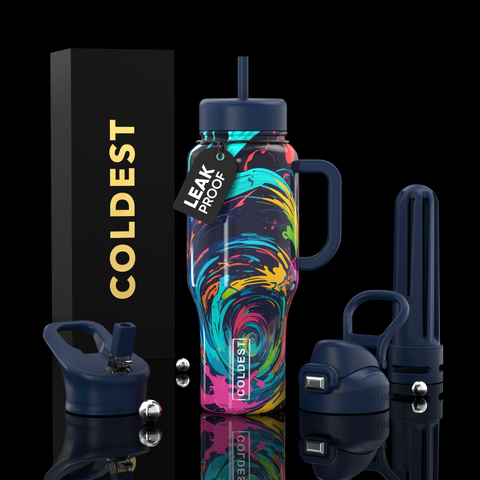
36oz Limitless and 46oz Limitless state hand wash only to protect the finish; don’t freeze or microwave. Want a big bottle with a handle? → 40 oz tumbler with handle and water bottle with handle — Coldest’s handle bottles come in 36oz and 46oz Limitless.
32oz Go Series
32oz Go Series shares the same hand wash only care. Shopping for a mid-size bottle? → 32 oz tumbler guide.
The 24oz Limitless follows the same hand-wash care; size hub → insulated water bottle sizes.
Lids
Sports, Sip, and Chug lids: if yours has a straw, that’s the Sip lid. Residue often hides in lid/threads—wash the path you used. Lid chooser → straw lid vs chug lid; full cleaning → how to clean a tumbler with straw. Dishwasher questions → can you put insulated tumbler in dishwasher.
Shop the bottles
Related guides
- Full clean → how to clean a tumbler with straw · Smell → why does insulated water bottle smell · Dishwasher → can you put insulated tumbler in dishwasher · Lids → straw lid vs chug lid
- How long ice lasts → how long do insulated water bottles stay cold · Vacuum → how vacuum insulation works · Lid sweat → why does tumbler lid sweat · Dent → does a dent mean tumbler vacuum failed
- Leak / size / shopping → leakproof tumbler checklist · insulated water bottle sizes · 40 oz vs 32 oz tumbler · 40 oz tumbler with handle · 32 oz tumbler guide · water bottle with handle · cup holder friendly tumblers · tumbler vs water bottle
FAQ
Why is there white residue in my water bottle?
Usually hard-water mineral scale — dissolved calcium and magnesium left behind as water dries into a chalky ring or cloudy film. It is a common stainless-bottle care issue, not proof the vacuum failed.
Is white residue the same as mold or a smell problem?
Not usually. Chalky / powdery film points to minerals; musty or moldy odor (especially on the lid, gasket, or straw path) is a different diagnosis — see Why does my insulated water bottle smell?. Full lid/straw clean: How to clean a tumbler with straw.
How do I remove white residue from a stainless bottle?
Empty, rinse, and hand-wash with mild soap. Common home methods for mineral film include a diluted white vinegar soak and/or baking-soda assist — then rinse thoroughly. For straw / Sip path, gasket, and deep steps, follow the full how-to: How to clean a tumbler with straw. Coldest Limitless and Go Series are hand wash only.
How do I prevent hard-water film from coming back?
Empty leftover water, rinse after use, and dry fully with the lid off before resealing. If film returns quickly on many kitchen surfaces too, that often points to harder source water—still clean the bottle. Deep clean cadence → how to clean a tumbler with straw.
Does white residue mean my vacuum insulation failed?
No — mineral film is a surface care issue inside the vessel, not a vacuum-gap failure. If cold/hot hold still feels normal, focus on cleaning. Duration: How long do insulated water bottles stay cold?. Vacuum basics: How vacuum insulation works.
Can I use the dishwasher to clear white residue?
No for Coldest Limitless and Go Series — Coldest product pages say hand wash only to protect the finish; don’t freeze or microwave. Dishwasher FAQ: Can you put an insulated tumbler in the dishwasher?. Full straw/lid clean: How to clean a tumbler with straw.
Closing
Why is there white residue in my water bottle? Usually hard-water mineral scale — chalky calcium/magnesium film left as water dries. For the full straw/lid/gasket routine → how to clean a tumbler with straw; musty smell → why does insulated water bottle smell. Shop: 32oz Go · 36oz Limitless · 46oz Limitless · Limitless bottles with handle. More care guides: cleaning, smell, the dishwasher, 40 oz tumbler with handle, and dents and vacuum failure.


